How to Read 2 Thessalonians
2 Thessalonians is the shortest and strangest of Paul's letters to this church — barely a page of Greek, and yet it contains the most difficult apocalyptic paragraph in the entire Pauline corpus. It has been mined for centuries as a prediction chart. It was written as a sedative.
Everything about the letter makes sense once you see what happened between the two letters. Paul wrote 1 Thessalonians to a young church under pressure. Then a report came back: the pressure had not eased, it had intensified — and worse, someone inside the community was teaching, apparently on Paul's own authority, that the Day of the Lord had already arrived. For people already being hurt for their allegiance to Jesus, that was a devastating thing to hear. If the Day has come and this is what it feels like, then either Jesus has abandoned us or we were never his.
Because the returning King will set everything right, a suffering church can refuse both panic and passivity — and get back to work.
Or, even shorter: hope that is true steadies you; hope that is counterfeit either terrifies you or excuses you.
The Central Question
Not "when is the end?" — but something far more urgent.
Has the Day of the Lord already happened — and did we miss it?
If God has not yet publicly judged the evil crushing us, has he seen it at all — and what are we supposed to do this week?
The one interpretive decision that governs the whole letter Paul assumes prior teaching
2 Thessalonians 2 gives you a rebellion, a man of lawlessness, a seat in the temple, a restrainer, counterfeit miracles, and a delusion sent by God — in twelve verses, with no explanation, because Paul explicitly says he already explained it in person: "Do you not remember that when I was still with you I told you these things?" (2:5).
That single sentence should govern how confidently anyone reads this passage. We are overhearing the compressed reminder of a conversation we did not attend. Paul is not building a chart for us; he is refreshing a memory for them. The honest posture is to trace the pattern Paul is invoking — which he draws straight from Isaiah, Daniel, and Jesus' own teaching — and to hold the specific identifications loosely. Augustine, who had access to a living Latin-speaking tradition far closer to Paul than ours, simply admitted he had no idea what the restrainer was (City of God 20.19). That is not a failure of nerve. It is accuracy.
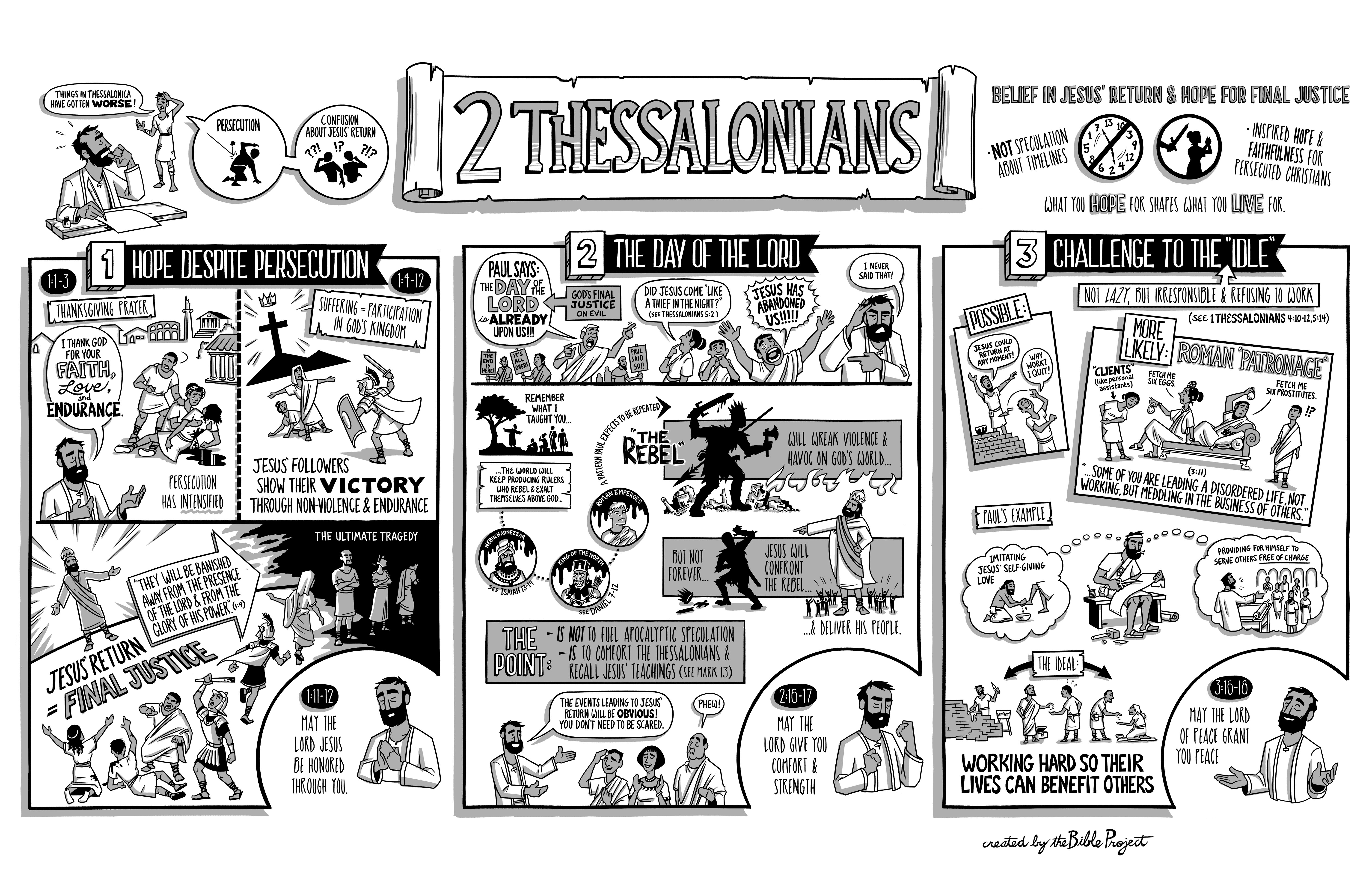
Visual orientation (BibleProject). Three sections answering three problems — hope despite persecution (ch. 1), the Day of the Lord (ch. 2), and a challenge to the idle (ch. 3) — each sealed by a short closing prayer, under the banner belief in Jesus' return and hope for final justice. Use it as a map before the deep dive below.
What Changed Between the Letters
2 Thessalonians is not a general treatise. It is a second response to a moving situation, and almost every difficulty in it dissolves once you know what had shifted on the ground.
① The persecution intensified
1 Thessalonians already assumed affliction. The second letter speaks of persecutions and afflictions the church is enduring in the present tense (1:4), and Paul's answer escalates accordingly — from "you are sharing the Messiah's pattern" to "God will repay."
② A message arrived in Paul's name
Something — "a spirit, a word, or a letter seeming to be from us" (2:2) — was circulating with the claim that the Day of the Lord had come. Paul does not say which it was; he seems not to know. He simply cuts all three wires at once.
③ The claim was in the perfect tense
The Greek ἐνέστηκεν (2:2) does not mean "is near." It means has arrived, is now present. The teaching was not that the end was soon — the church already believed that. It was that the end had started, and this was it.
④ The idleness had gotten worse
Paul had already told this church to work with their hands and mind their own affairs (1 Thess 4:11). In the second letter the same people are still not working (3:11) and now the instruction comes with a command and a consequence.
⑤ Paul signs it himself
The autograph at 3:17 — "this is the mark in every letter of mine" — gives the church a concrete authentication measure after 2:2 has raised the possibility of a letter represented as apostolic. In a world without envelopes or notarization, a hand-written closing in a scribe-written letter was a recognizable mark from the sender.
⑥ The temple memory was fresh
Roughly a decade before this letter, the emperor Caligula ordered his own statue installed in the Jerusalem temple (AD 40). Only his assassination stopped it. For Paul's generation, a ruler enthroning himself in God's house was not theory.
⑦ The tone cooled
Readers have noticed for two centuries that this letter is more formal and less affectionate than the first — no "we were gentle among you like a nursing mother." That shift is real, and it is part of the authorship conversation below.
A note on authorship, handled honestly Disputed
More scholars question Paul's authorship of 2 Thessalonians than of 1 Thessalonians. The case against, developed by William Wrede and later Wolfgang Trilling, rests on three observations: the letter tracks 1 Thessalonians unusually closely in structure yet feels cooler in tone; its eschatology seems to sit awkwardly beside 1 Thess 5:2 (a thief in the night) by supplying signs that must come first; and the insistence on a signature at 3:17 can read as a forger's overcorrection.
The case for authenticity — argued by Abraham Malherbe, Charles Wanamaker, Gordon Fee, and Jeffrey Weima, among others — answers each: the external attestation is early and unanimous, with no ancient dispute at all; the two eschatologies address different questions (how suddenly versus has it already happened) and each letter says the church is not in the dark; and a forger warning readers against forged letters is a peculiar strategy. The occasion itself accounts for the tone: a second letter to the same church about a distortion of the first will naturally be more clipped.
Working position on this site. These pages read 2 Thessalonians as what it presents itself to be — Paul's letter, co-sent with Silvanus and Timothy, written within months of the first — while flagging the debate wherever it actually bears on interpretation. The Commentary & Context page lays out both sides at length.
Three Problems, Three Sections, Four Prayer-Wishes
The architecture of this letter is unusually easy to see, and seeing it is most of the interpretive battle. Paul takes the three problems in the church one at a time and closes each treatment with a short prayer-wish. A fourth prayer-wish opens the final treatment at 3:5, and the letter ends with a grace benediction at 3:18. The prayers are not decoration — they are the seams, and they tell you where one argument ends and the next begins.
Problem: the affliction has intensified and it looks like God is doing nothing. Answer: your endurance is evidence, not absence — and God himself will repay, so you don't have to.
Problem: someone claims the Day has already come. Answer: no — and here is the pattern you already know, so that you can stop being shaken and start standing firm.
Problem: some are refusing to work and meddling in everyone else's business. Answer: imitate the example you watched me live — work, so that your life becomes a benefit rather than a burden.
Three problems · three sections · three closing prayer-wishes · one hinge prayer-wish · one grace benediction
Notice what this architecture does to the famous apocalyptic paragraph. 2:1–12 is not the center of the letter, standing alone as a revelation of the end. It is the middle panel of a triptych, wedged between "God sees your suffering" and "so get back to work" — and it is resolved by a prayer for comfort. The genre of 2 Thessalonians 2 is pastoral care.
The Letter's Governing Themes
Six convictions run underneath all three sections. They are the reason a letter about a first-century rumor still preaches.
Justice Belongs to God
Paul uses the language of repayment — God will pay back affliction to the afflicters and relief to the afflicted. Crucially, this is what releases the church from retaliation. Vengeance is not denied; it is relocated, out of their hands and into God's.
Endurance Is Evidence
Their steadfastness under pressure is called "evidence of the righteous judgment of God" (1:5). The suffering is not proof that God has withdrawn; the capacity to endure it faithfully is proof that God is at work.
Evil Follows a Pattern
Paul is not describing a one-off villain; he is naming a recurring shape — the ruler who exalts himself into God's place. Scripture has seen it before, the church will see it again, and it always ends the same way.
The Rebel Is Not a Rival
When the confrontation finally comes, it is not a battle. Jesus destroys him "with the breath of his mouth" and abolishes him by the sheer fact of showing up. Whatever terror the church feels, the outcome is never in doubt.
Hope Produces Work
The practical test of a healthy eschatology is whether it gets you out of bed. False hope makes people quit their jobs or panic; true hope sends them back to ordinary labor done for the sake of others.
Stand Firm and Hold On
Paul's repeated imperative is not "figure it out" but "hold fast to what you were taught." Stability under apocalyptic pressure comes from memory and community, not from decoding.
How the Letter Is Built
Three literary moves carry most of the argument. Each is developed with diagrams on the Literary Design page; here is the orientation.
① The rebel as counterfeit King
Paul gives the man of lawlessness two of the same key terms he uses for Jesus. The rebel is revealed (2:3, 6, 8) as Jesus is revealed (1:7), and he has a παρουσία, a royal arrival (2:9), as Jesus has a παρουσία (2:1, 8). Around those direct echoes Paul builds broader contrasts: the rebel comes with power, signs, and wonders "of falsehood" and works by Satan's ἐνέργεια (2:9), while God's work establishes the church in truth.
The rebel is a parody, and parody is the point: evil has no material of its own. It can only imitate.
② Prophetic texts, quietly loaded
Two lines that sound like Paul's own invention are near-quotations. "Away from the presence of the Lord and from the glory of his power" (1:9) tracks the Greek of Isaiah 2:10, 19, 21. "The Lord Jesus will slay him with the breath of his mouth" (2:8) tracks Isaiah 11:4. The self-exalting ruler of 2:4 is drawn in the lines of Daniel 11:36 and Ezekiel 28:2.
Paul is not predicting from scratch. He is reading his moment through Israel's prophets — which is exactly how he expects the church to read theirs.
③ The wordplay that gives the third section its bite
In 3:11 Paul says some are μηδὲν ἐργαζομένους ἀλλὰ περιεργαζομένους — literally "not working, but working around." English translations reach for "not busy, but busybodies" to catch it. The joke has teeth: the energy these people are not spending on their own livelihood is being spent on everyone else's affairs. Idleness is never merely private; it always relocates into interference.
The Letter in Three Passes
Under pressure
ComfortThanksgiving → their growing faith → God's just repayment → the revealing of Jesus → prayer that God complete them.
Under deception
CorrectionThe false claim → what must come first → the rebel and the restrainer → his undoing by a word → chosen from the beginning → prayer for comfort and establishment.
Under disorder
RestorationPrayer for the mission → the Lord is faithful → prayer for their hearts → Paul's own labor as the pattern → correction bounded by kinship → prayer for peace → the signature → grace to all.
A compressed walk through each section. The full exegetical treatment, movement by movement, is on the Movement Commentary page.
① 1:1–12 · Thanksgiving, endurance, and the justice of God
Paul opens by thanking God that their faith is growing abundantly and their love for one another increasing (1:3) — note what is missing from the triad. In the first letter he praised their faith, love, and hope; here hope is the thing under attack, so he praises the two that are holding and spends the rest of the letter repairing the third. He then boasts about them to other churches for their ὑπομονή, their endurance under pressure (1:4).
The theological center of the section is a tight piece of symmetry (1:6–7): God will repay affliction to those who afflict you, and to you who are afflicted, ἄνεσις — relief, the loosening of a strain. The justice is exact, and it is God's to administer. What follows in 1:8–9 is sobering and deliberately restrained: those who refuse to know God suffer "eternal destruction, away from the presence of the Lord." Paul names a final outcome but does not explain its mechanism or how the word "eternal" bears on duration. Readers should preserve both what he states and what he leaves unexplained.
② 2:1–17 · The Day has not come
Paul's request is emotional before it is doctrinal: don't be "quickly shaken in mind or alarmed" (2:2). The verb suggests a boat torn from its moorings. Then the argument: the Day cannot already have come, because the sequence you were taught has not run. First the rebellion; then the revealing of the man of lawlessness, who opposes and exalts himself above every so-called god and takes his seat in God's temple, proclaiming himself to be God (2:3–4).
Then the notorious verses. Something restrains him — neuter in 2:6, personal in 2:7 — and the church already knows what it is (2:6). The "mystery of lawlessness" is already at work (2:7), which is Paul's way of saying that what they are suffering is not outside the pattern. And when the rebel is finally unveiled, Jesus will destroy him effortlessly (2:8). Verses 9–12 describe the counterfeit's power and the terrible reciprocity of judgment: because they "refused to love the truth," God gives them over to the delusion they preferred.
The section ends where it should: chosen, called, loved, told to stand firm and hold to what they were taught (2:13–15).
③ 3:1–18 · Work, order, and peace
Paul asks for prayer, expresses confidence, prays for them (3:1–5) — and then turns to the hardest pastoral problem in the letter. Some in the community are living ἀτάκτως (3:6), a word describing disorderly or out-of-place conduct. Its older military associations supply the useful picture of someone out of formation, but not the word's complete definition here. Paul appeals first to his own example — he worked night and day so as not to burden anyone, though he had every right to support (3:7–9) — and then to a rule he had already given them: if anyone is not willing to work, let him not eat (3:10).
That line has been badly abused, so its grammar matters: οὐ θέλει is about willingness, not ability. Paul is addressing people who could work and have chosen a dependent life instead. Plausible background One influential explanation locates this dependence in the Roman patronage system, where a client attached himself to a wealthy household and lived off its unpredictable generosity; the letter does not identify the cause, and other explanations remain possible. The correction ends with a guardrail that is easy to skip and essential to keep: do not treat such a person as an enemy, but warn him as a brother (3:15).
Key Passages
Six texts carry the letter. Read these slowly and the rest opens up.
"This is evidence of the righteous judgment of God." The suffering itself is not the evidence — their faithful endurance within it is. A church that keeps loving under pressure is already a preview of the verdict.
Affliction to the afflicters, relief to the afflicted. The exactness is the comfort — and the reason the church can absorb violence without returning it.
Echoing Isaiah 2:10, 19, 21. The tragedy Paul names is relational: those who wanted nothing to do with the Lord finally receive exactly that.
The pastoral thesis of the whole letter. Whatever the source of the claim — spirit, word, or letter — the response is stability, not investigation.
The mystery of lawlessness is operating now; the rebel will be revealed later; and Jesus ends him with a breath. Present evil is real, bounded, and already defeated in principle.
The quiet summary of the whole letter's ethic. Not heroics — persistence.
A Four-Sitting Reading Plan
2 Thessalonians can be read aloud in ten minutes, and it should be — at least once — before it is dissected. Then work the sections.
Sitting 1 · The whole letter, aloud
Read all three chapters in one pass without stopping at the hard parts. Mark every time Paul prays. You will find the letter's skeleton without any commentary at all.
Sitting 2 · Chapter 1 with Isaiah 2 and 66
Read 2 Thess 1 alongside Isaiah 2:10–21 and Isaiah 66:15–16. Watch how much of Paul's language about the Lord's appearing is borrowed rather than invented.
Sitting 3 · Chapter 2 with Daniel 11 and Mark 13
Read 2 Thess 2:1–12 next to Daniel 11:36–37 and Mark 13:5–27. The goal is to recognize the pattern Paul assumes his readers already know — and to notice how consistently Jesus and Paul both say do not be alarmed.
Sitting 4 · Chapter 3 with 1 Thess 4:9–12
Read the two work passages together. The second is the first one repeated with more force, which tells you how seriously Paul took an ethic most modern readers treat as filler.
Questions for Study and Discussion
Why does "God will repay your persecutors" land as comfort rather than cruelty?
Because it is addressed to the victims, not the bystanders. The promise removes the burden of retaliation from people who have no power to retaliate anyway — which is precisely why Paul can tell the same church to repay no one evil for evil. The question worth pressing: what changes when a church stops receiving that promise and starts trying to administer it?
1:5 calls their endurance "evidence." Evidence of what?
Not that they are trying hard enough, but that God's judgment is right and that they are being made worthy of the kingdom. It reframes a season of suffering as something with a direction. Try reading your own hardest season for evidence rather than for explanation and notice how differently the question sits.
What are the modern equivalents of the false teaching?
The mark of it in Thessalonica was not that it was wrong about dates. It was that it made an already-persecuted church more afraid. Any teaching about the future whose practical effect is panic, withdrawal, or paralysis is doing what that message did, whatever its chart says.
Why is memory a better anchor than analysis here?
Paul's actual instruction for apocalyptic anxiety is "stand firm and hold to the traditions that you were taught" (2:15) — not decode, remember. Analysis of an under-specified passage produces confident answers that cannot be checked. Memory returns you to what was clear when you were calm.
If eschatology is tested by whether it produces ordinary faithful work — how does yours score?
This is the letter's own test, applied in chapter 3. A view of the future that makes you a better neighbor, a steadier worker, and a harder person to deceive passes. One that makes you anxious, speculative, or disengaged fails, however well it maps the sequence.
Where does "warn him as a brother, not an enemy" get hardest to hold?
Usually at the point where the boundary starts to feel satisfying. 3:14 authorizes real distance; 3:15 forbids that distance from becoming a verdict on the person. Holding both requires wanting the person back more than you want to be right about them.
Sources & Companion Pages
This overview is a doorway; the deep work lives on the companion pages. The readings above lean on the following.
Key Sources
Foundations for the reading offered here
Key Sources
Foundations for the reading offered here
Primary Text
Commentaries
Framing
Background
Scripture quotations: English renderings follow the ESV unless otherwise indicated, with adjustments made directly from the Greek where a translation decision is part of the argument — notably at 2:2, 2:13, and 3:6–11. The Greek text is Nestle-Aland 28.
On BibleProject sources: video and visual-commentary material is used as primary framing, reflecting the literary-design and canonical-reading methodology that shapes Project Context studies.
On named positions: where this study attributes a view to a scholar not listed above — Wrede and Trilling on authorship, Cullmann and Tertullian on the restrainer, and others — the position is reported as surveyed in the commentaries and introductions cited here, not consulted in the original. The works listed are the ones actually used.
Citation Format: Chicago Manual of Style, 17th edition.